UroLift Treatment for Enlarged Prostate (BPH) in Pune
Dr. Rajesh Dhake > UroLift Treatment
Holding the Passage Open, Instead of Reshaping It
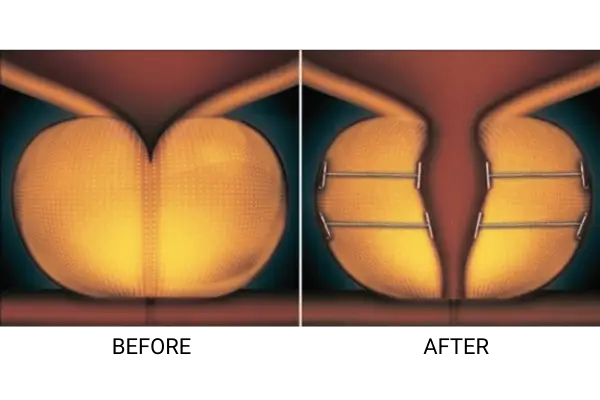
Most BPH treatments work by removing tissue, heating it, or applying gradual pressure to reshape it over time. UroLift takes a mechanically simpler approach: it physically pulls the enlarged prostate tissue back away from the urethra and holds it there with a handful of small permanent implants, opening up the urinary channel almost immediately. No tissue is cut, burned, or destroyed in the process — the obstruction is simply lifted out of the way.
What Is UroLift?
UroLift is a minimally invasive procedure that uses small, permanent implants — think of them as tiny anchors — to hold enlarged prostate tissue away from the urethra, relieving the compression that’s causing urinary symptoms. Each implant is placed using a specialized delivery device passed through the urethra, with no incision anywhere on the body. The implants themselves are typically made of a combination of nitinol and stainless steel, materials chosen for their long-term biocompatibility, since unlike iTind, these implants are designed to remain in place permanently.
How the Procedure Works
Pre-procedure evaluation
Cystoscopy and imaging assess prostate size and anatomy to confirm UroLift is a suitable fit, since the technique works best within a specific range of prostate sizes and shapes.
Anesthesia
The procedure is typically performed under local anesthesia with sedation, or occasionally general anesthesia, and does not usually require an overnight hospital stay.
Implant delivery
A specialized delivery system is passed through the urethra to the treatment site. Under direct visualization, small implants are placed to compress and hold back the obstructing prostate tissue, opening the urethral channel.
Number of implants
The number placed varies by patient, typically ranging from a few to several, depending on the size and shape of the prostate and how much tissue needs to be held back.
Completion
Once the implants are in place and the channel is confirmed to be open, the procedure is complete — there’s no tissue removal, cauterization, or additional recovery step required at the treatment site itself.
The entire procedure is usually completed within about an hour, often less, and many patients notice symptom improvement within just a few weeks.
Why Men Consider UroLift Over Other BPH Options
- Rapid symptom relief — because the mechanism is purely mechanical (physically holding tissue open), many men notice improved urine flow relatively quickly compared to treatments that rely on gradual tissue remodeling
- No cutting, heating, or tissue removal — the prostate tissue itself isn’t damaged or destroyed, only repositioned
- Preserves sexual function — UroLift has a strong track record of preserving both erectile and ejaculatory function, making it a frequently chosen option for men prioritizing this alongside symptom relief
- Outpatient procedure — typically performed without a hospital stay, with many patients resuming normal activities within a few days
- No catheter usually required afterward — unlike some other BPH procedures, many patients don’t need an extended period of catheterization following treatment
- Reversible in principle — because nothing is cut or ablated, the procedure doesn’t foreclose other treatment options later if needed
Who Might Be a Good Candidate
UroLift is generally considered for men with:
- Bothersome lower urinary tract symptoms from BPH — weak stream, urgency, frequent urination, or incomplete emptying
- A prostate size and shape that falls within the range best suited to the implant-based approach, confirmed through pre-procedure evaluation
- A strong preference to preserve sexual function, given the procedure’s track record in this area
- A wish to avoid the ongoing cost and side effects of daily BPH medication, or the more invasive nature of traditional surgery
Men with certain prostate shapes — particularly a prominent middle lobe extending into the bladder — may not be ideal candidates, which is why a thorough anatomical evaluation comes before any treatment decision.
What Recovery Feels Like
Because UroLift doesn’t involve cutting or tissue removal, recovery is generally quick. Mild irritation, urgency, or a temporary burning sensation during urination is common in the days immediately following the procedure, gradually easing as the tissue adjusts to the new implant positions. Most men return to normal daily activity within a few days, and unlike procedures involving tissue removal, an extended catheterization period usually isn’t necessary.
How UroLift Compares to Other Minimally Invasive BPH Options
Where iTind uses a temporary device removed after about a week and Rezum uses steam to actively shrink prostate tissue, UroLift takes tissue out of the equation entirely — it doesn’t attempt to reduce prostate volume at all, only to mechanically hold the obstructing portion out of the urinary channel’s path using implants left permanently in place. This makes it a genuinely different mechanism from either of those options, and the right choice between them comes down to prostate size, shape, and personal priorities, best discussed directly during a consultation.
Frequently Asked Questions
What is UroLift, and how does it treat BPH?
UroLift is a minimally invasive procedure that uses small, permanent implants to hold enlarged prostate tissue away from the urethra, relieving the compression causing urinary symptoms. It works mechanically, without cutting, heating, or removing any prostate tissue.
Are the UroLift implants permanent?
Yes, the implants are designed to remain in place permanently, holding the prostate tissue open on an ongoing basis. This differs from devices like iTind, which are temporary and removed after 5 to 7 days.
Does UroLift affect sexual function?
UroLift has a strong track record of preserving both erectile and ejaculatory function, which is one of the main reasons it’s frequently chosen by men who want to prioritize this alongside symptom relief.
How quickly does UroLift relieve BPH symptoms?
In selected patients, particularly those with smaller localised tumours, kidney-sparing surgery such as partial nephrectomy may be possible. The decision depends on tumour size, location, kidney function and other clinical factors.
Is UroLift a painful procedure?
The procedure is typically performed under local anesthesia with sedation, so discomfort during treatment is minimal. Mild irritation or a burning sensation during urination is common for a few days afterward, gradually easing as the tissue adjusts.
How long does the UroLift procedure take?
The procedure is usually completed within about an hour, often less, and typically doesn’t require an overnight hospital stay.
Is a catheter needed after UroLift?
Unlike some other BPH procedures, many patients don’t need an extended period of catheterization after UroLift, which contributes to its relatively quick recovery.
Who is not a good candidate for UroLift?
Men with certain prostate shapes, particularly a prominent middle lobe extending into the bladder, may not be ideal candidates. A thorough evaluation, including cystoscopy and imaging, is needed to confirm suitability before the procedure.
How is UroLift different from Rezum or iTind?
UroLift uses permanent implants to mechanically hold tissue open without reducing prostate volume, while Rezum uses steam to actively shrink prostate tissue and iTind uses a temporary device removed after about a week. Each works through a different mechanism, and the right choice depends on prostate size, shape, and personal priorities.
How long does the improvement from UroLift last?
UroLift is intended to provide durable, long-term symptom relief, with the implants remaining in place indefinitely to keep the urinary channel open. As with any BPH treatment, individual results can vary based on prostate size and how the condition progresses over time.
What are UroLift implants made of?
The implants are typically made of a combination of nitinol and stainless steel, materials chosen for their long-term biocompatibility, since the implants are designed to remain in the body permanently.
